D:\SPACE\GJ_667_C_C>
SELECTED WORLDGJ 667 C c
GJ 667 C · M1.5 V host star · cool red dwarf · main sequence
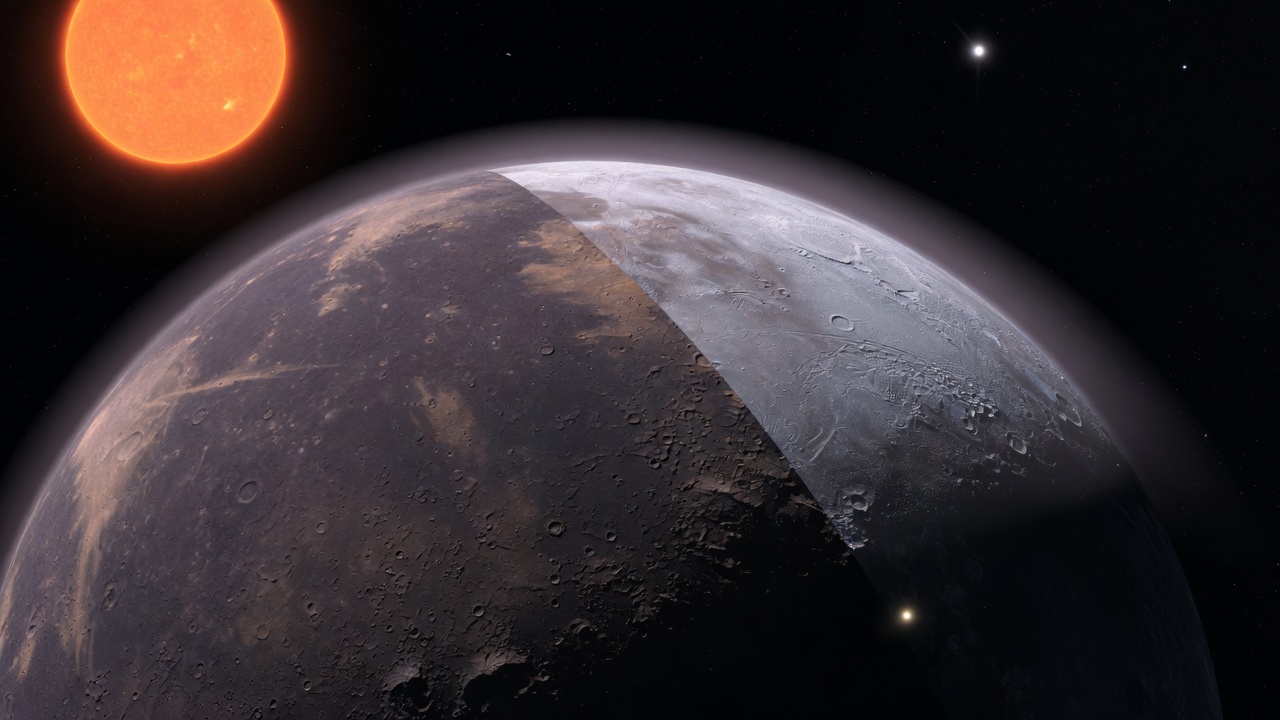
Star temperature and orbital distance set incoming energy, but stellar size is also required. This calculation uses a typical radius for the listed spectral type, 30% reflectivity and even heat redistribution. It is not a ground-temperature forecast: air, clouds, oceans and surface reflectivity could move the result by tens to hundreds of degrees. A likely synchronous spin also means the permanent day and night sides would not share one ground temperature.
The marker above the bar is a typical temperature for this star’s class. The line below is Earth’s Sun.
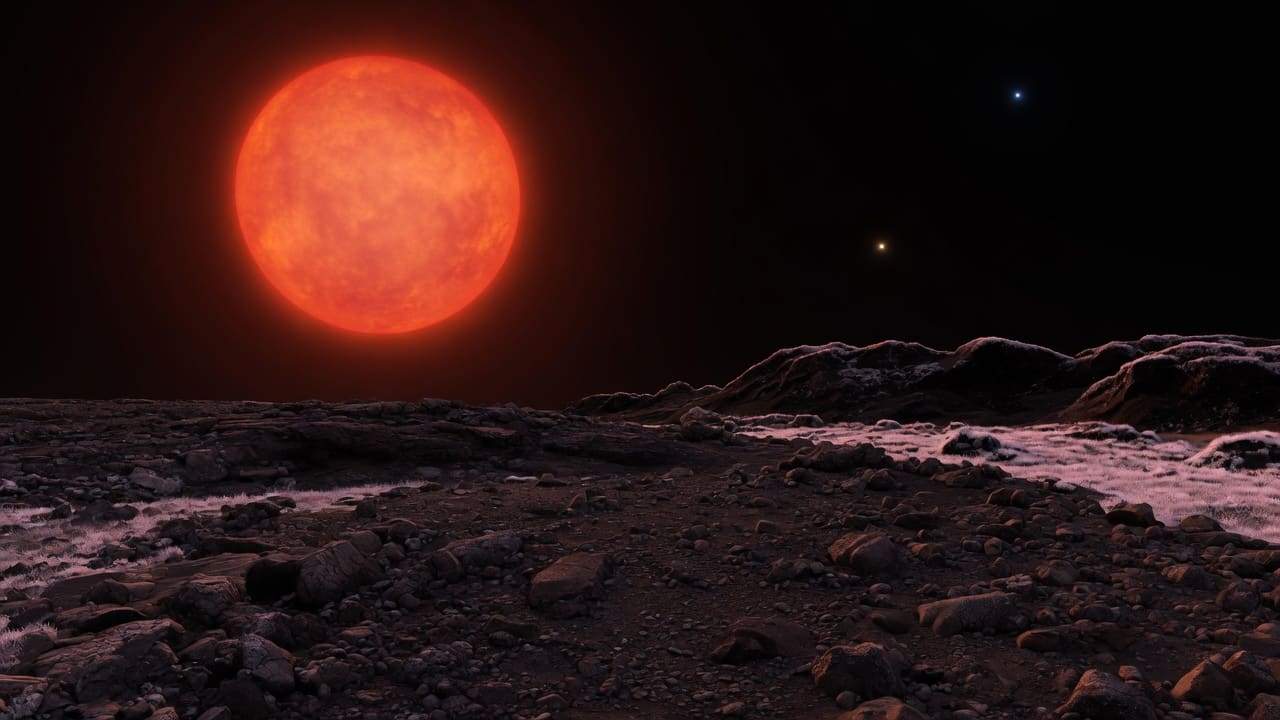
GJ 667 C is class M1.5 V. Its visible daylight would be dim and strongly red-orange; most of its energy is infrared.
Representative lit-side geometry only. On a locked world, the star’s real elevation would depend on where you stand.
Most plausible case. The best-supported planet in a disputed system. It receives about 88% of Earth’s light on a 28-day orbit. From the star’s luminosity and 3350 K temperature, the star is about 0.35 solar radii and about 1.5° across in this sky. A fixed red-orange sun, dark rock, night-side ice, and a possible water patch under the star. Planets e and f are more contested than c.
Dry case. Red rock and dust, ice only on the night side. Less extreme than GJ 3323 b because the flux is near Earth’s, not 2.6 times it.
Thick-air case. A cloudy sky could hide the ground. The flux does not demand a steam atmosphere.
Walking. About 21% heavier than Earth, modelled. GJ 667 C b is a small disk. Planet f, if real, would look about 0.4 of the Moon’s width. GJ 667 A and B, at least 230 AU away, are bright points, not second suns. The host is magnitude 10.6, 24 light-years away.
Based on: Anglada-Escudé et al. 2012/2013; Teff 3350 K, L 0.014 Lsun, S 0.88, a 0.125 AU. Archive has no stellar radius; about 0.35 Rsun follows from that luminosity and temperature.
GJ 667 C c circles GJ 667 C alone. GJ 667 C is at least 230 AU from the A–B pair; A and B vary from about 5 to 20 AU apart. Also shown: GJ 667 C b, GJ 667 C e, GJ 667 C f, GJ 667 C g, each on its NASA-catalogued orbit. Use Higher and Lower to move your viewpoint above, through and below the orbital plane, and − / + to zoom. Orbit shapes and spacing are schematic.
Positions, distances, and system parameters come from the NASA Exoplanet Archive composite table, queried 25 Sep 2026. GJ 273 b uses the parallax in that row, 12.4 light-years. The 45 worlds follow Bohl, Lawrence, Lowry, and Kaltenegger.
