D:\SPACE\KEPLER_1410_B>
SELECTED WORLDKepler-1410 b
Kepler-1410 · K7V host star · orange star · main sequence
Star temperature and orbital distance set incoming energy, but stellar size is also required. This calculation uses a typical radius for the listed spectral type, 30% reflectivity and even heat redistribution. It is not a ground-temperature forecast: air, clouds, oceans and surface reflectivity could move the result by tens to hundreds of degrees.
The marker above the bar is a typical temperature for this star’s class. The line below is Earth’s Sun.
Kepler-1410 is class K7V. Its daylight would have a warmer orange-gold cast than sunlight on Earth.
Representative daytime geometry only; the star’s height in the sky changes through the day.
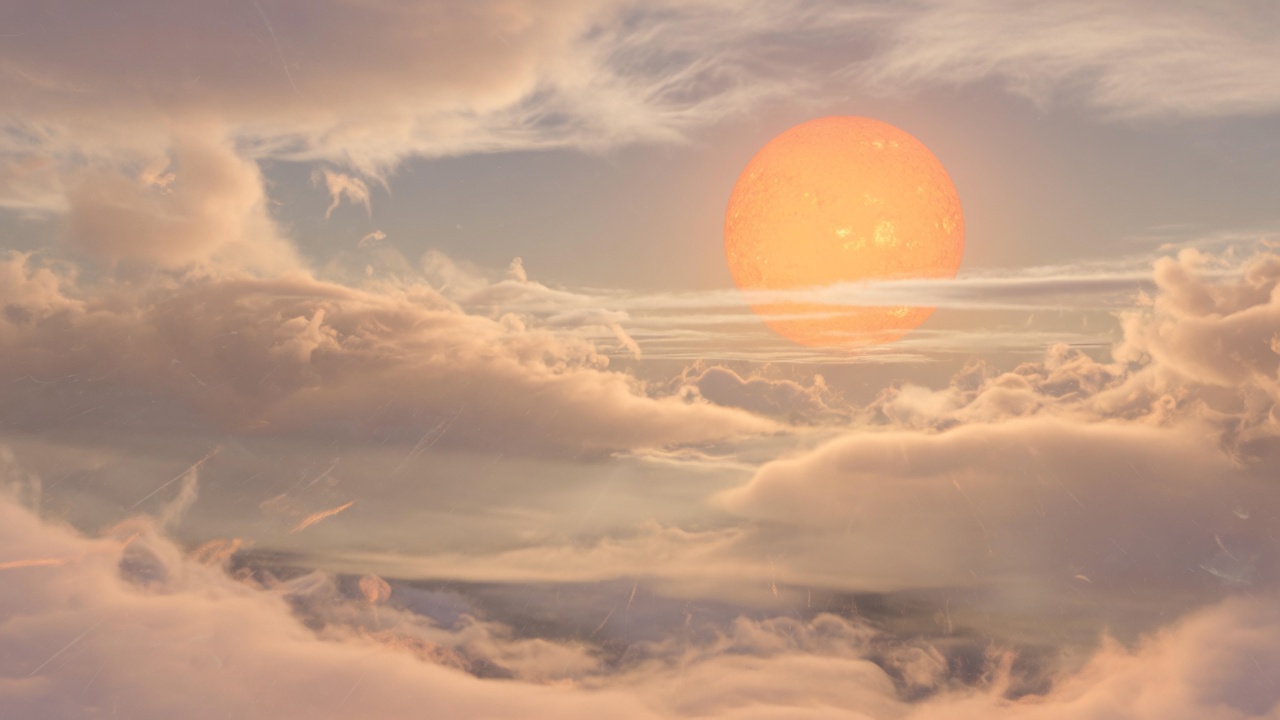
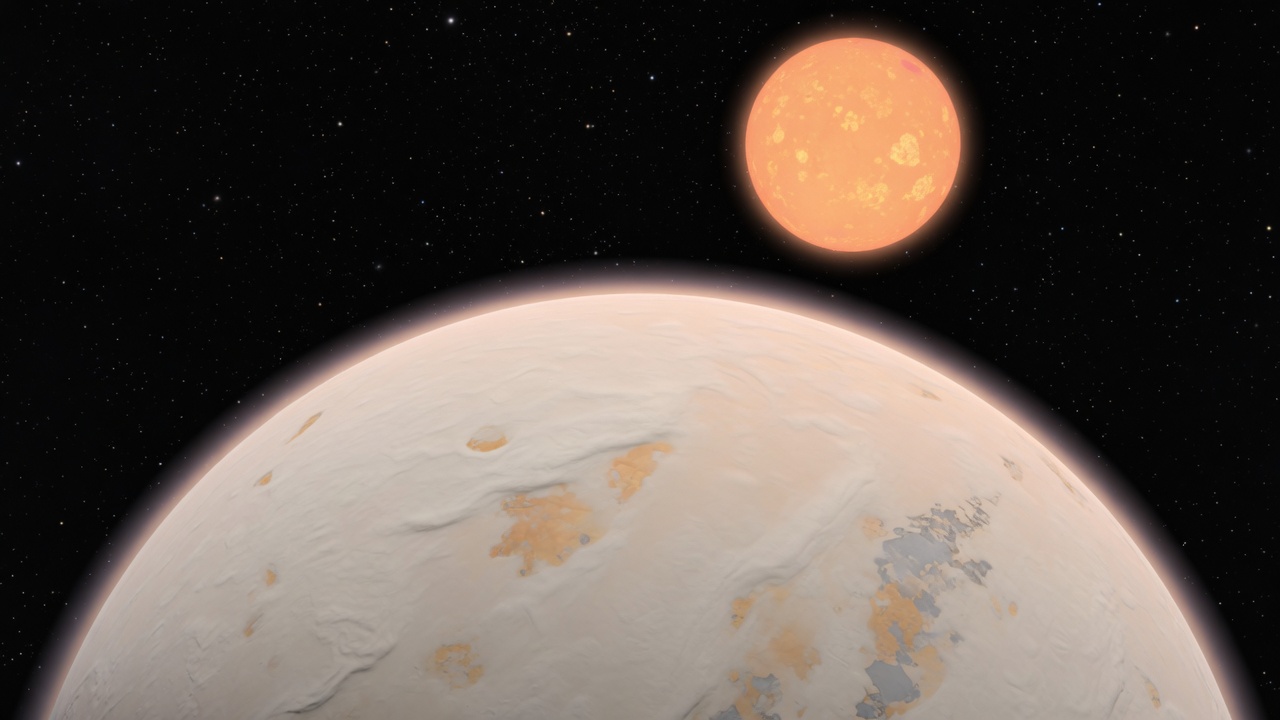
Most plausible case. A K dwarf, about 4090 K and 0.60 solar radii, not a deep red M star. From 0.25 AU it spans about 1.3° and delivers about Earth’s light. Radius 1.78 Earth radii is large for bare rock. The more common reading is a rocky core under a volatile layer. If you could see ground, it would be temperate rock under an orange sun, with the spin uncertain at this distance.
Dry case. Warm rock and dunes under orange light, if the volatiles were lost. That is the less common size bin.
Thick-air case. The likelier view. A cloudy envelope, and no visible ground. The radius does that work without any special assumption.
Walking. About 21% heavier than Earth only in a rocky model. If the planet is puffy, that weight is wrong. No known sibling. The star is magnitude 16, about 1,200 light-years away.
Based on: NASA composite; Teff 4092 K, R 0.60 Rsun, S 1.06, Rp 1.78, a 0.254 AU. Spectral type on the page is estimated.
Kepler-1410 b circles Kepler-1410. Use Higher and Lower to move your viewpoint above, through and below the orbital plane, and − / + to zoom. Orbit shapes and spacing are schematic.
Positions, distances, and system parameters come from the NASA Exoplanet Archive composite table, queried 25 Sep 2026. GJ 273 b uses the parallax in that row, 12.4 light-years. The 45 worlds follow Bohl, Lawrence, Lowry, and Kaltenegger.
