D:\SPACE\KEPLER_441_B>
SELECTED WORLDKepler-441 b
Kepler-441 · K5V host star · orange star · main sequence
Star temperature and orbital distance set incoming energy, but stellar size is also required. This calculation uses a typical radius for the listed spectral type, 30% reflectivity and even heat redistribution. It is not a ground-temperature forecast: air, clouds, oceans and surface reflectivity could move the result by tens to hundreds of degrees.
The marker above the bar is a typical temperature for this star’s class. The line below is Earth’s Sun.
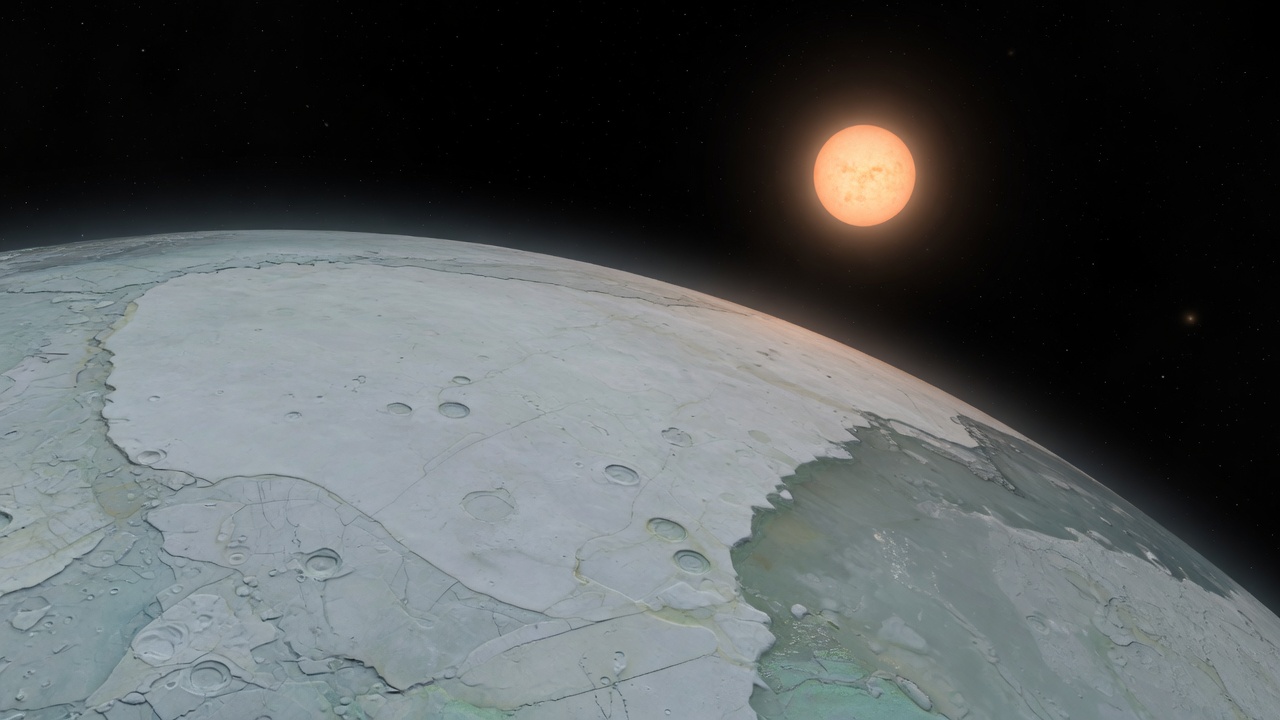
Kepler-441 is class K5V. Its daylight would have a warmer orange-gold cast than sunlight on Earth.
Representative daytime geometry only; the star’s height in the sky changes through the day.
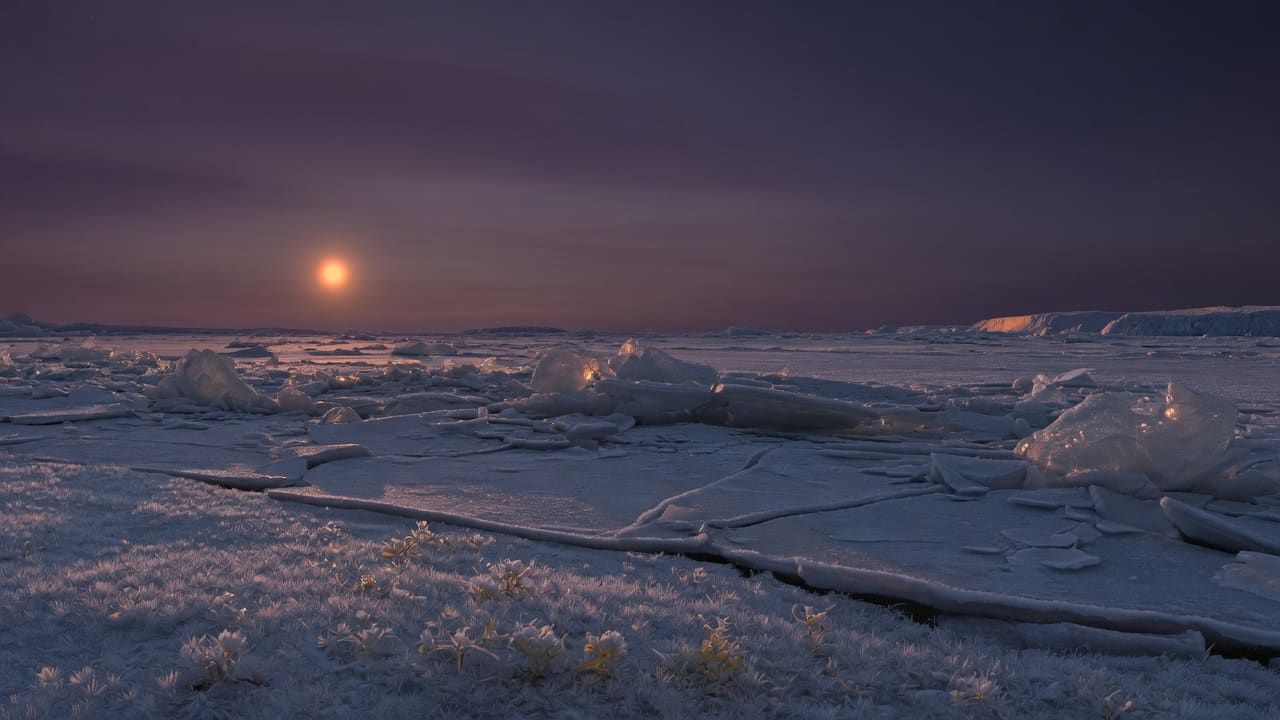
Most plausible case. A cold K-dwarf orbit. The star is 4340 K and 0.55 solar radii, and from 0.64 AU it spans only about 0.46°, slightly smaller than the Sun looks from Earth. The planet receives about a fifth of Earth’s light. That is outer-edge dim. Ice and frost are the plausible ground. The 207-day year makes a fixed dayside unlikely. Radius 1.64 Earth radii, mass modelled.
Dry case. Frozen rock. Not a desert of heat shimmer.
Thick-air case. A thick CO₂ sky is the paper habitability story for a flux this low. It would hide the ground under cloud and is not observed.
Walking. About 24% heavier than Earth, modelled. No known neighbor. Daylight is orange and faint, a small sun in a cold sky. The star is magnitude 16, about 880 light-years away.
Based on: NASA composite; Teff 4340 K, R 0.55 Rsun, S 0.21, Rp 1.64, a 0.64 AU
Kepler-441 b circles Kepler-441. Use Higher and Lower to move your viewpoint above, through and below the orbital plane, and − / + to zoom. Orbit shapes and spacing are schematic.
Positions, distances, and system parameters come from the NASA Exoplanet Archive composite table, queried 25 Sep 2026. GJ 273 b uses the parallax in that row, 12.4 light-years. The 45 worlds follow Bohl, Lawrence, Lowry, and Kaltenegger.
