D:\SPACE\TRAPPIST_1_G>
SELECTED WORLDTRAPPIST-1 g
TRAPPIST-1 · M8.0 V host star · cool red dwarf · main sequence
Star temperature and orbital distance set incoming energy, but stellar size is also required. This calculation uses a typical radius for the listed spectral type, 30% reflectivity and even heat redistribution. It is not a ground-temperature forecast: air, clouds, oceans and surface reflectivity could move the result by tens to hundreds of degrees. A likely synchronous spin also means the permanent day and night sides would not share one ground temperature.
The marker above the bar is a typical temperature for this star’s class. The line below is Earth’s Sun.
TRAPPIST-1 is class M8.0 V. Its visible daylight would be dim and strongly red-orange; most of its energy is infrared.
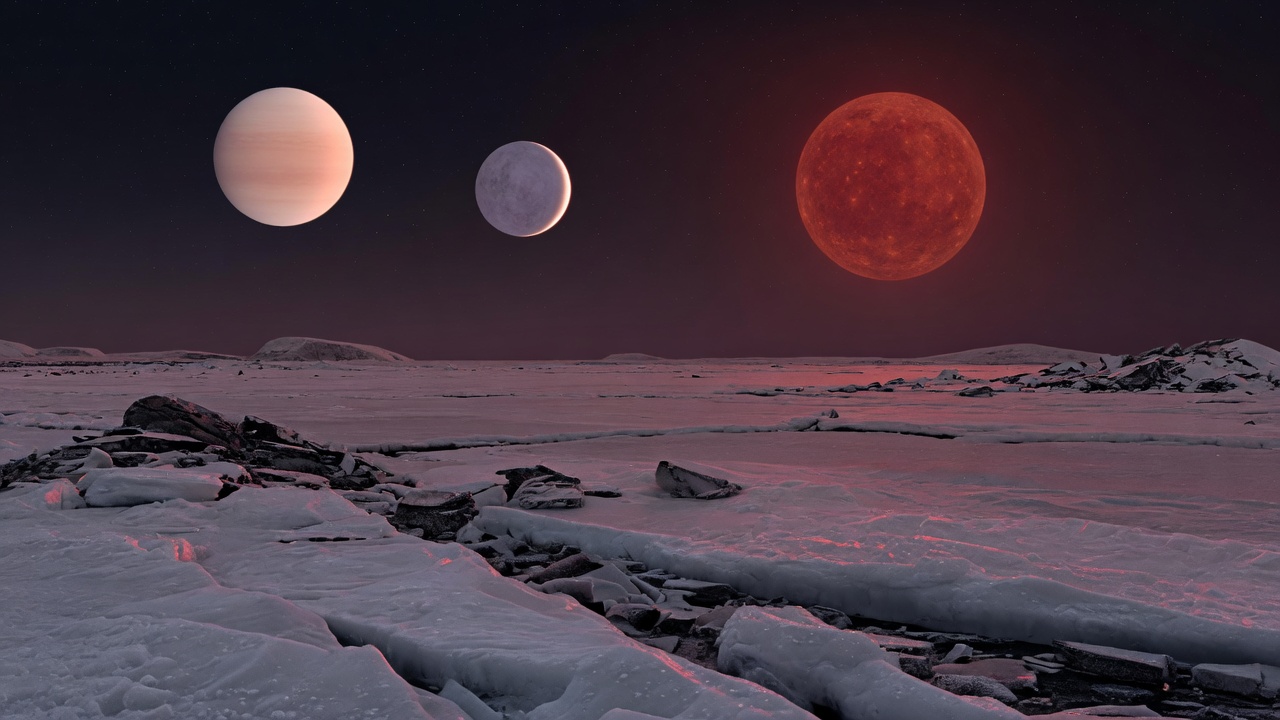
Representative lit-side geometry only. On a locked world, the star’s real elevation would depend on where you stand.
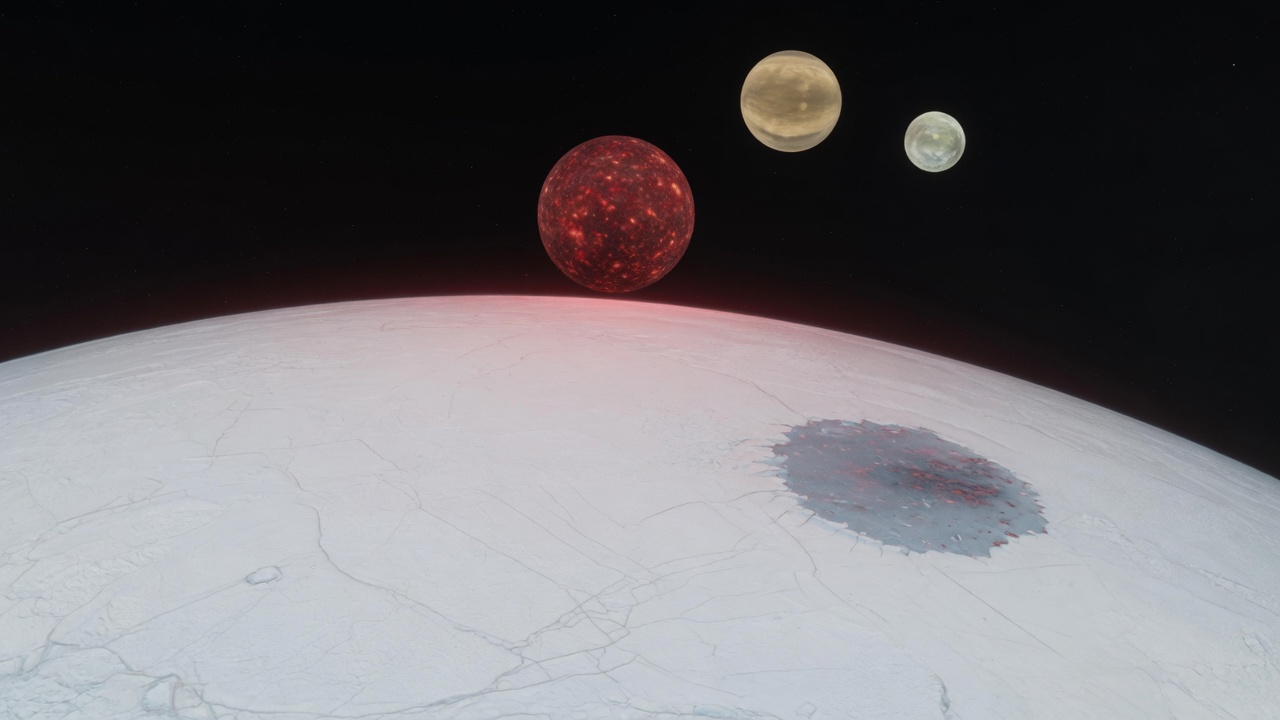
Most plausible case. The coldest TRAPPIST world in this catalog. About a quarter of Earth’s light. Radius 1.13 and mass 1.32, gravity about 1.04 g, measured, slightly heavier than Earth. The star spans about 1.4°. An ice-covered day side is the straightforward picture. Rock shows through only if the greenhouse is strong or the ice is thin under the star.
Dry case. Frozen rock and dust. Little reason to expect a warm desert at this flux.
Thick-air case. A thick CO₂ atmosphere could make a temperate surface under cloud. Without it, g is an ice world with a red star in a dark sky.
Walking. Slightly heavier than Earth, measured. Planet f would look about 1.2 times the Moon’s width, and h about half. The star is the smallest-looking of the four TRAPPIST worlds in this list, and still wider than the Sun.
Based on: Agol et al. 2021; S 0.25, Rp 1.13, Mp 1.32, a 0.047 AU
TRAPPIST-1 g circles TRAPPIST-1. Also shown: TRAPPIST-1 b, TRAPPIST-1 c, TRAPPIST-1 d, TRAPPIST-1 e, TRAPPIST-1 f, TRAPPIST-1 h, each on its NASA-catalogued orbit. Use Higher and Lower to move your viewpoint above, through and below the orbital plane, and − / + to zoom. Orbit shapes and spacing are schematic.
Positions, distances, and system parameters come from the NASA Exoplanet Archive composite table, queried 25 Sep 2026. GJ 273 b uses the parallax in that row, 12.4 light-years. The 45 worlds follow Bohl, Lawrence, Lowry, and Kaltenegger.
